
Chapter 8 · plan without false certainty
Implementation understanding and decisions
A practical sequence for building what the design already specifies — with Open items called out so diagrams do not silently decide them.
Proposed implementation sequence
- Proposed Choose backend/runtime, durable schemas, account authorization, API boundaries — preserve entity ids, evidence timestamps, ownership semantics. Prototype
localStorageis not the architecture. - Proposed Signed distribution and collector lifecycle for macOS, Windows, Fedora/Linux, Raspberry Pi; validate ESP32 board/UPS matrix and real storage budget; secure local credentials; USB/NUT/SNMP adapters.
- Proposed Offline buffer, sequence/dedupe, observation-vs-receipt, clock uncertainty, gaps, aggregates, incident evaluation, notification delivery — replay suppression without suppressing new active evidence.
- Port Lattice tokens/components; strip prototype review chrome from production builds.
- Visual/browser acceptance remains a separate unverified obligation from the design handoff.
Broadwater as first real site
Recommendation Use Broadwater-like always-on Pi + dual UPS as an early pilot shape because the design already stresses revocation, network identity duplicates, and mixed USB/SNMP sources there. The handoff does not define a commercial pilot program. The review copy of the acceptance pass is the Broadwater pilot acceptance checklist. Passing it does not choose storage, operator login, or a release order for the other platforms. The replay scenario on that list is the Broadwater outage walkthrough: utility, then WAN, then replay, using bw-pi-01 and ups-bw-rack.
Suggested acceptance scenarios (recommendation)
- Enroll → first contact → first reading with roles applied
- Broadwater outage walkthrough: utility fails, WAN fails later, local collection continues, replay restores history, and a fresh reading recovers the incident
- Witness-down while another witness reports (collector failure, not site loss)
- Revoke → 401 → re-enroll keeps history/UPS links
- Battery replacement creates new installation; prior evidence retained but non-qualifying
Operational concerns
- Retention — prototype 7-day UI ≠ production policy (Open)
- Upgrades / distribution — signed artifacts per platform (Proposed)
- Hardware compatibility — publish validated matrices; keep ESP32 illustrative until proven
- Monitoring MainsKeeper itself — collector doctor, backlog stalled alerts, cloud reachability exit 7 in CLI design
Cost drivers (no vendor prices)
Volume scales with collectors × sources × cadence × retention. Buffer disk, ingest bandwidth, notification volume, and Assurance history storage dominate before UI cost. Do not assume free-tier operation.
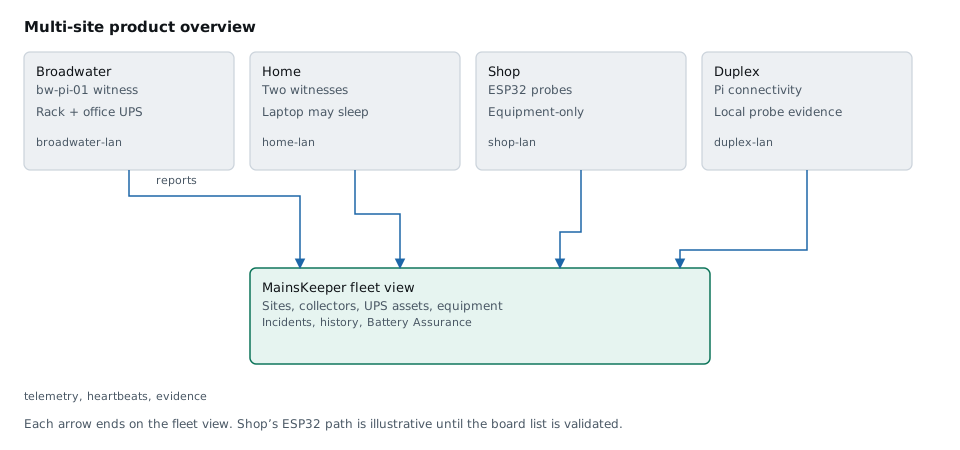
Figure 1. Multi-site product overview
Takeaway: Traceability anchor: sites and collectors in the design fleet map to dashboard mockups and CLI status examples.
Mockups: product/app/index.html, site.html, collectors.html, ups.html
Traceability
| Requirement theme | Guide | Handoff anchors |
|---|---|---|
| Fleet visibility | Ch.1–2 | product/app/index.html, site.html |
| Collector/source ops | Ch.3,5 | collectors.html, sources.html, network-source.html, CLI |
| Incidents / history | Ch.4–5 | incidents.html, history.html, sync.html |
| Battery Assurance | Ch.7 | CONTRACT.md §22, assurance.js, UPS panel |
| Open decisions | Register | implementation.html §7 |
Continue to the decision register for items that most need review this round.