
Reference
Interface catalog
Component boundaries with status labels. Illustrative JSON appears in Chapter 5. Logical boundaries are below. Sequence diagrams for enroll and replay: enrollment and replay.
Enrollment
- Purpose
- Bind a newly installed collector to an account/site and issue credentials.
- Producer → consumer
- Collector CLI / firmware → Dashboard + enrollment service
- Direction / transport
- Collector initiates; operator approves. Transport: HTTPS or equivalent (Proposed)
- Identity / ownership
- Short enrollment code; collector device identity; site id
- Minimum information
- Code, platform, discovered sources, requested roles
- Timing / freshness
- Code TTL (design: 10 min); approval before first contact
- Success / failure / retry
- Approved → credential; expired/denied/offline variants; re-enroll keeps history
- Auth / credentials
- Credential never in URL/CLI logs; local after approval
- Versioning
- Additive enrollment protocol versions (Open)
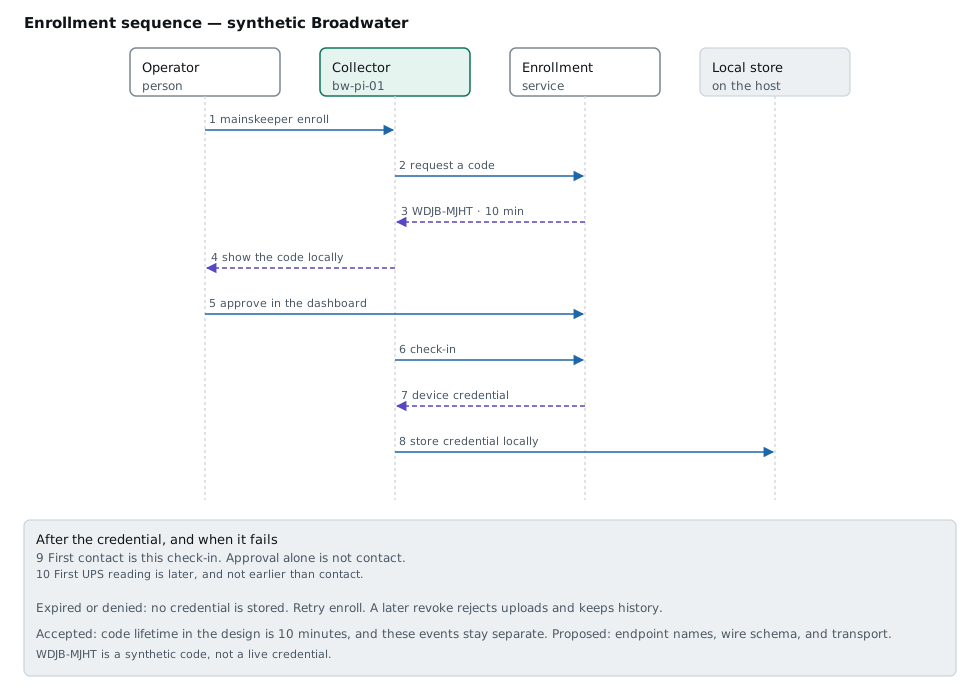
Enrollment sequence
Takeaway: Approval, first contact, and the first UPS reading are three events. The code WDJB-MJHT is a synthetic example from the design, not a live credential.
Legend: solid blue = request · dashed purple = response · Accepted behaviour · Proposed wire
Related: Collector · Secret status · Chapter 5 overview · Pilot checks · SVG source
Telemetry upload
- Purpose
- Deliver observations and heartbeats for durable history and current state.
- Producer → consumer
- Collector → Ingestion service
- Direction / transport
- Collector push. Transport: HTTPS batches (Proposed)
- Identity / ownership
- collectorId + sequence / dedupe keys
- Minimum information
- observedAt, readings, heartbeats, optional events
- Timing / freshness
- Reporting interval vs heartbeat independent; replay allowed
- Success / failure / retry
- Ack advances cursor; 401 revoked; 503 retry; duplicates idempotent
- Auth / credentials
- Collector credential; UPS secrets not included
- Versioning
- schema id in payload (illustrative)
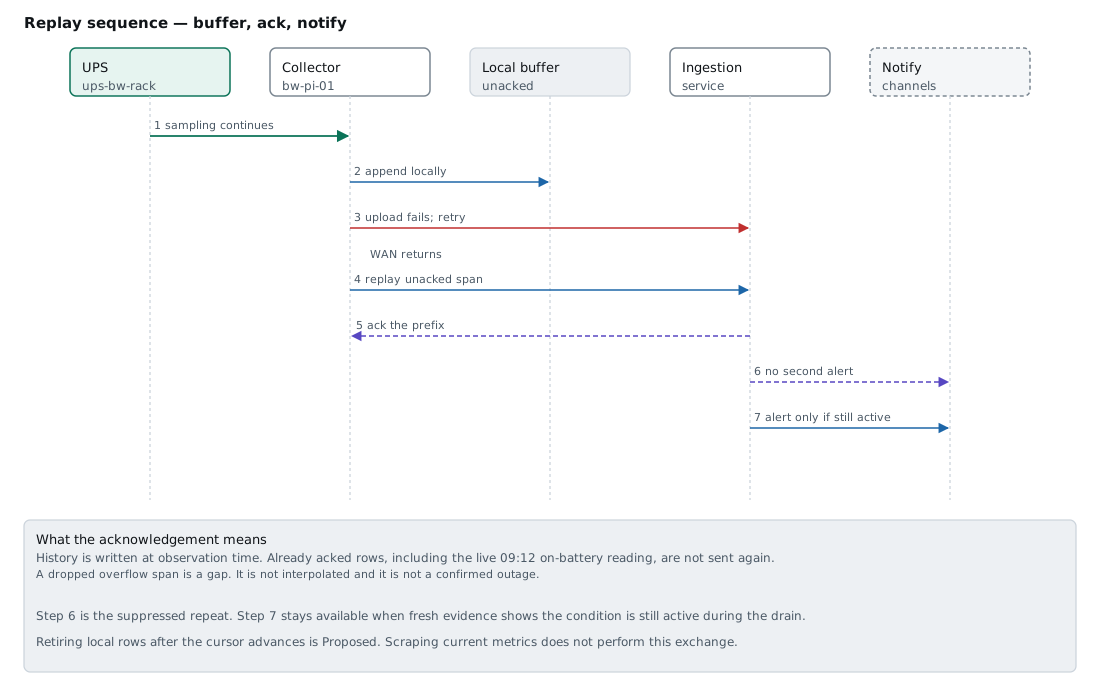
Replay and acknowledgement sequence
Takeaway: Replay updates history at observation time. A missing heartbeat does not prove a power failure. Scraping current metrics does not perform this exchange.
Legend: solid blue = data moving forward · dashed purple = acknowledgement · dashed gray = notification suppressed for the historical condition · Accepted semantics · Proposed wire
Related: Heartbeat · Chapter 4 buffer figure · Pilot checks · SVG source
Desired configuration
- Purpose
- Distribute dashboard-managed settings to collectors.
- Producer → consumer
- Dashboard → Collector (on check-in)
- Direction / transport
- Pull on check-in / contact. Transport: With telemetry session (Proposed)
- Identity / ownership
- collectorId + config keys
- Minimum information
- desired values for site, roles, intervals, connectivity targets
- Timing / freshness
- Applied at next check-in; asleep/lost stay pending
- Success / failure / retry
- applied | failed(reason) | waiting
- Auth / credentials
- Dashboard auth for operators; collector auth for pull
- Versioning
- key-level compatibility
Local source secrets
- Purpose
- Store NUT/SNMP credentials for source tests and reads.
- Producer → consumer
- Operator on collector → Local secret store
- Direction / transport
- Local only. Transport: OS keychain / secrets.d / DPAPI / device page
- Identity / ownership
- source id
- Minimum information
- secret material never uploaded
- Timing / freshness
- Required before successful network test
- Success / failure / retry
- Configured / Missing / Rejected reflected to dashboard
- Auth / credentials
- No dashboard delivery channel
- Versioning
- n/a
Current-state & history query
- Purpose
- Serve fleet UI and CLI status from stored evidence.
- Producer → consumer
- Query API → Dashboard / CLI
- Direction / transport
- Request/response. Transport: HTTPS (Proposed)
- Identity / ownership
- account + site/ups/collector ids
- Minimum information
- latest readings, freshness, unknown spans, incidents
- Timing / freshness
- Freshness badges; history by observation time
- Success / failure / retry
- Standard read errors; never fabricate gaps
- Auth / credentials
- Operator session (Proposed provider)
- Versioning
- API versioning Open
Notification delivery
- Purpose
- Deliver declared incidents and Assurance reminders.
- Producer → consumer
- Incident / notify service → Email, push, other channels
- Direction / transport
- Outbound. Transport: Channel-specific (Proposed)
- Identity / ownership
- incident id / rule id
- Minimum information
- severity, evidence summary, deep link
- Timing / freshness
- After declare; retries on failure
- Success / failure / retry
- Delivery log; reminder dedupe; snooze ≠ resolve
- Auth / credentials
- Channel credentials server-side
- Versioning
- template versioning
Metrics scrape (standalone path)
- Purpose
- Expose current-state gauges for Prometheus.
- Producer → consumer
- Collector metrics endpoint → Prometheus
- Direction / transport
- Pull scrape. Transport: HTTP /metrics (Proposed)
- Identity / ownership
- collector instance labels
- Minimum information
- current gauges only — not historical gap fill
- Timing / freshness
- Scrape interval ≠ durable retention
- Success / failure / retry
- Stale metrics on silence; no replay via scrape
- Auth / credentials
- Network ACL / scrape auth Open
- Versioning
- metric name stability
Assurance evidence & findings
- Purpose
- Record evidence and resolve protection findings.
- Producer → consumer
- Operators / collectors / UPS reports → Assurance module
- Direction / transport
- Mixed write paths. Transport: API + UI (Proposed wire; Accepted rules)
- Identity / ownership
- batteryInstallationId, evidence ids
- Minimum information
- source, occurrence, outcome, load, duration bounds
- Timing / freshness
- Age from occurrence; policy windows
- Success / failure / retry
- Guarded resolve requiring documentation
- Auth / credentials
- Operator auth; no hardware write
- Versioning
- policy document version
Logical boundaries inside the running path
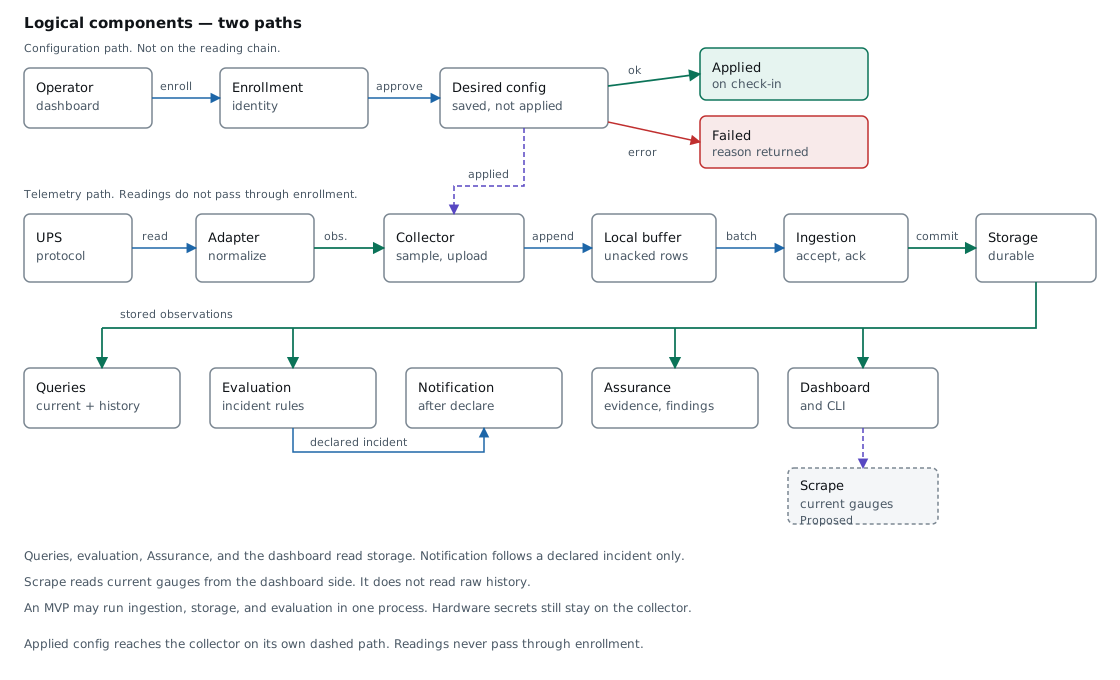
These cuts explain ownership. They are not an instruction to deploy a process per box. An MVP can keep the adapter inside the collector, and ingestion, storage, and evaluation in one service. Hardware secrets still do not move.
UPS protocol ↔ adapter
- Purpose
- Turn a USB-HID, NUT, or SNMP read into a normalized observation. No control command crosses this line.
- Producer → consumer
- UPS firmware → adapter inside the collector or probe.
- Direction / transport
- Adapter requests a status read. The UPS returns readings or a timeout. Transport is the device protocol, not the MainsKeeper API.
- Identity / ownership
- Source identity: namespace, protocol, host, port, and NUT name where the protocol has one. The adapter does not own the UPS asset id.
- Minimum information
- Observation time, power state, and any reported fields. Unsupported and not-reported stay distinct. Missing is not 0.
- Timing / freshness
- The collector’s reporting interval. A timeout becomes UPS communication lost only after the accepted 2 minutes, and only while the collector itself is reporting.
- Success / failure / retry
- A read either normalizes or is recorded as a communication failure. The adapter does not retry by issuing a self-test. ESP32 does not speak the full NUT stack.
- Auth / credentials
- Network secrets stay in the collector’s local store. The adapter may use them. It does not upload them.
- Versioning
- Which UPS models answer is an open validation list, especially on ESP32. See d7.
- Contract
- §2 monitoring only · §18.1 source identity
Adapter ↔ collector
- Purpose
- Hand the collector one observation, or a clear communication failure, without the collector speaking USB or SNMP itself.
- Producer → consumer
- Adapter → collector scheduler. The collector asks. The adapter answers.
- Direction / transport
- In-process on host collectors. On ESP32 the same responsibility is firmware, not a second service. Transport inside the process is Open.
- Identity / ownership
- Collector owns cadence, roles, and which source is active. Adapter owns the protocol details.
- Minimum information
- Source id, observation time, normalized fields, support flags.
- Timing / freshness
- Independent of heartbeat. A quiet UPS is not a missed heartbeat.
- Success / failure / retry
- The collector records the result and decides whether to sample again. The adapter does not upload and does not evaluate incidents.
- Auth / credentials
- None of its own. It uses the local secret the collector already holds.
- Versioning
- Normalized field names should stay stable even if a protocol library changes. The field list is Proposed.
- Contract
- §2 · Figure 5
Collector ↔ local durable buffer
- Purpose
- Keep observations that ingestion has not durably accepted, including across a collector restart on a host.
- Producer → consumer
- Collector writes. Collector reads the unacked span back for upload. The server never writes this store.
- Direction / transport
- Local disk, or flash on a probe. Engine is Open except that browser storage in the prototype is not it.
- Identity / ownership
- Collector owns the bytes. Sequence numbers are per collector.
- Minimum information
- Observation time, source, payload, sequence. Receipt time does not exist yet.
- Timing / freshness
- Append before the upload attempt, so a crash between sample and send does not drop the row.
- Success / failure / retry
- Overflow drops the oldest span and must surface a gap. Those rows are gone. Do not invent them at reconnect.
- Auth / credentials
- UPS secrets are a different local store. They are not rows in the telemetry buffer.
- Versioning
- When a local row may be deleted: only after the acknowledgement cursor covers it. That rule is Proposed. ESP32 capacity figures stay illustrative (d7).
- Contract
- §15.4 · Walkthrough 09:20 · Figure 8
Ingestion ↔ durable storage
- Purpose
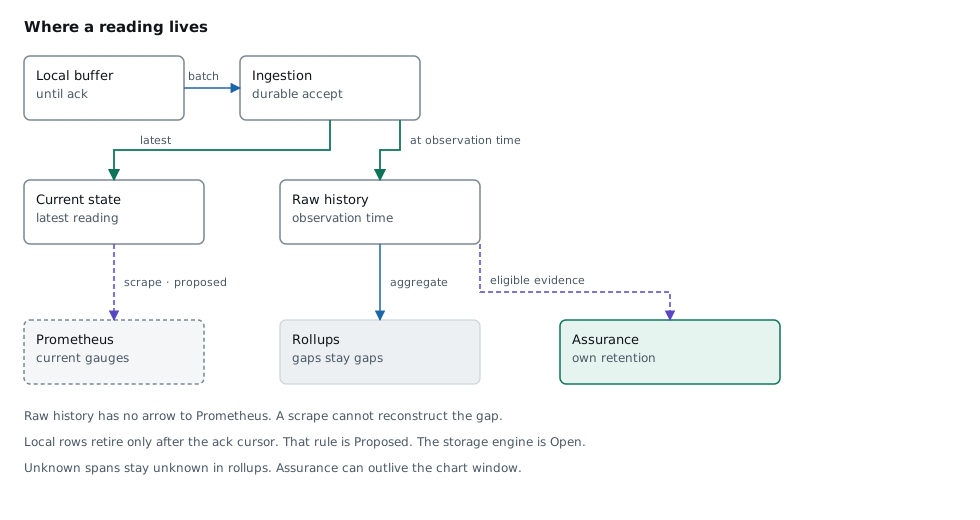
- Make an accepted batch survive independently of the collector, at observation time, without collapsing current state and history into one blob.
- Producer → consumer
- Ingestion writes. Queries, evaluation, and Assurance read. See the next boundary.
- Direction / transport
- In-process or a database call. Not specified. Choosing a database is d2.
- Identity / ownership
- Account, collector, source, UPS asset, and battery installation stay distinct keys.
- Minimum information
- Observation time, receipt time, sequence, payload, and a gap marker when a span was dropped.
- Timing / freshness
- Durable accept is the point the acknowledgement cursor may move. Until that write succeeds, the collector must keep the rows.
- Success / failure / retry
- A duplicate sequence does not create a second history row (idempotency). A failed write does not ack. Replay and live ingest share this rule.
- Auth / credentials
- The collector credential was already checked before this write. UPS secrets are absent.
- Versioning
- Schema ids in examples are illustrative. Retention of raw history versus Assurance is a separate open window.
- Contract
- §15.4 · §18.3 · Figure 13
Stored observations ↔ evaluation and queries
- Purpose
- Let the dashboard, CLI, and incident rules read one stored record without sampling the UPS again.
- Producer → consumer
- Storage → current-state query, history query, incident evaluation, and Battery Assurance. Evaluation → notification only after declare.
- Direction / transport
- Read path. May be the same process as ingestion. Transport is Open.
- Identity / ownership
- Queries do not create observations. Evaluation does not rewrite history to hide a gap.
- Minimum information
- Latest reading and its age, unknown spans, incident timestamps, and installation-scoped evidence.
- Timing / freshness
- Freshness uses the accepted cadence rule (§18.4), not a universal 60 seconds. Current and last known stay labelled.
- Success / failure / retry
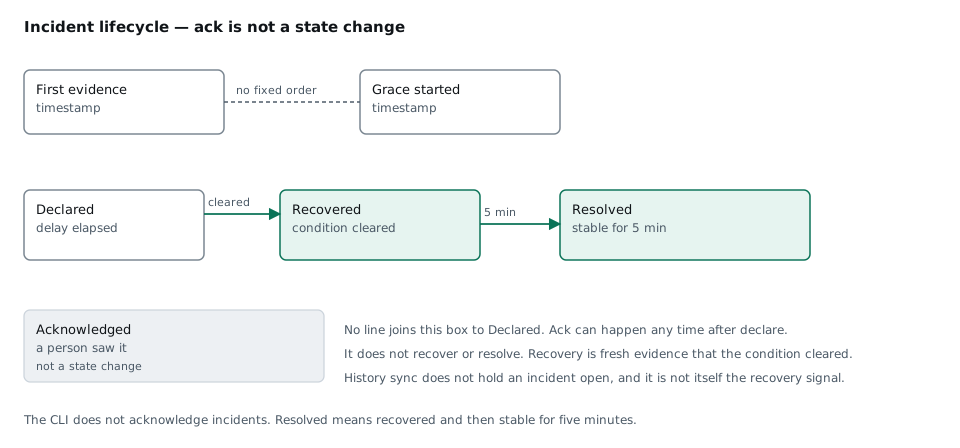
- A missing id is not found, never a substituted neighbor. Evaluation declares, recovers, and resolves from evidence rules. Acknowledgement is not an input to recovery.
- Auth / credentials
- Operator session for dashboard and CLI. That provider is d3. Evaluation itself is not an operator action.
- Versioning
- Changing storage engines must not merge “reads” with “powers,” or contact age with UPS reading age.
- Contract
- §15.2–§15.3 · Figure 5 · Figure 11
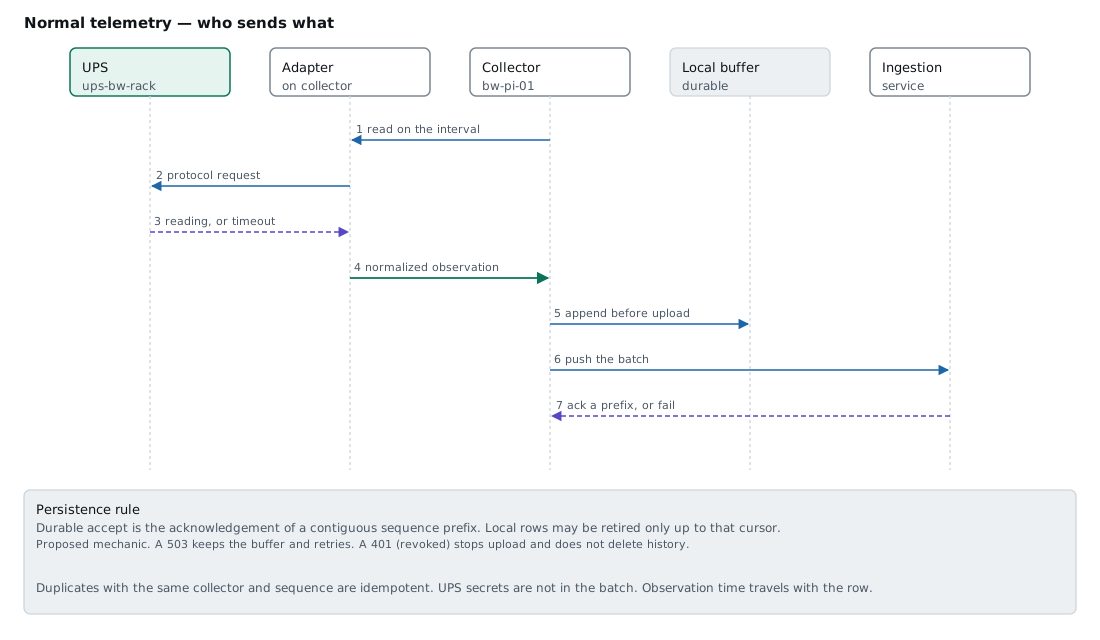
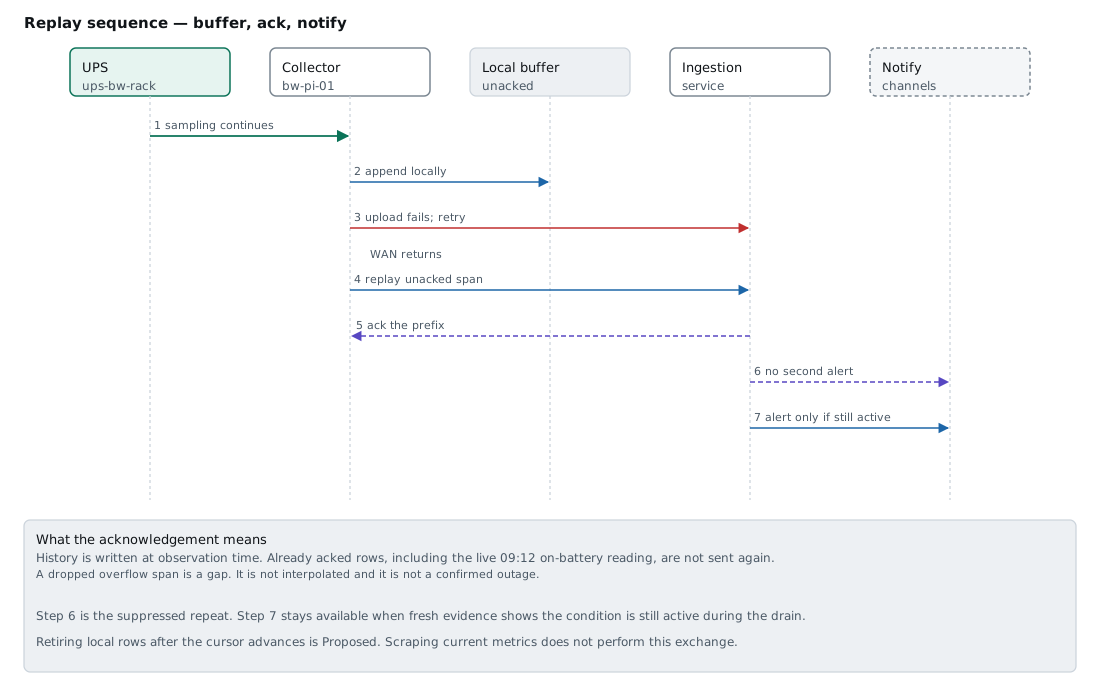
Telemetry sequence (Figure 7)
Takeaway: The same drawing as Chapter 4. Append happens before upload. Acknowledgement is what makes the prefix durable.